Physical Skills
Technical Skills

Tactical Skills

Mental Skills

Attacking Skills
Defensive Skills

Legacy

Identity

Pref. Moves
– Moves into channels
– Shoots with power

Stats
Club
Apps: 549
Goals: 97
Goal Ratio: 0,17
Career Span (yrs): 15
National Team
Apps: 73
Goals: 10
Goal Ratio: 0,13
Career Span (yrs): 13
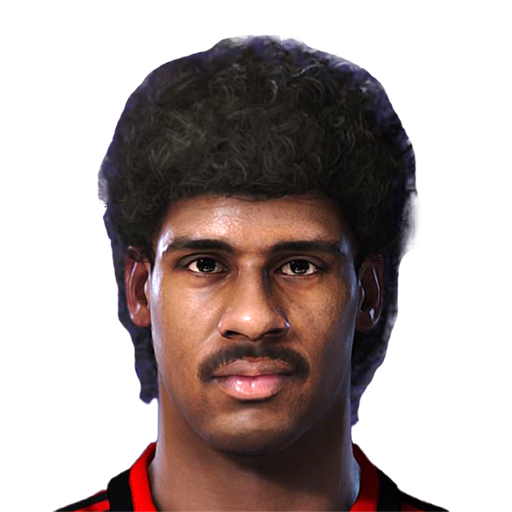
Frank Rijkaard is one of the most complete footballers the Dutch school has ever produced, which already places him in rare air. At Milan he formed the legendary Dutch trio with Ruud Gullit and Marco van Basten, but among the three he was often the one who held everything together. If Van Basten was the finisher and Gullit the force of nature, Rijkaard was the equilibrium point, the player who made the entire system function with logic and authority.
Trying to assign him a single role feels almost disrespectful. Rijkaard was a defender, a holding midfielder, a box to box runner, an organiser, a creator of balance and sometimes even a deep playmaker. He could start as a centre-back and step into midfield as if he had spent his whole career there. He could operate as a mediano who screened the defence with perfect timing. He could surge forward and break lines with the power and control of a modern eight. He could drift into advanced positions and combine like an attacking midfielder. Everything felt natural to him.
His physical profile made him terrifyingly complete. Tall, strong, fast, explosive over distance and agile in tight spaces, he combined power with a fluid elegance that made his movements look effortless. Technically he was excellent. Clean first touch, calm under pressure, sharp passing both short and long, and the ability to dribble just enough to escape danger without unnecessary flair. His shooting from distance was a weapon. His heading ability made him dominant in both boxes. And defensively he was formidable: great sense of timing, strong in duels, tactically disciplined and capable of reading passing lanes with near-perfect anticipation.
What separated him from many all rounders was his intelligence. Rijkaard understood the geometry of the pitch in a way that allowed him to cover, compensate, and connect lines instinctively. He was the player who filled the gaps left by others, who ensured Milan’s pressing had structure, who restored order when the game tilted into chaos. In Sacchi’s famously demanding system, where distances and synchronisation were everything, Rijkaard felt like the natural centre of gravity. Even with giants around him, he was often the most essential piece.
His leadership style was understated but unmistakable. He didn’t need theatrics. Teammates trusted him because he radiated calm and authority. When he stepped onto the pitch, Milan seemed to gain an extra layer of stability. When he stepped off it, you could feel the difference.
In the history of Dutch football he is often mentioned just after the creative geniuses and the prolific scorers, but many insiders will quietly tell you he was the most complete of them all. And in that Milan side, filled with world class talent at peak maturity, Rijkaard was the spine, the shield and the compass.