Physical Skills
Technical Skills

Tactical Skills

Mental Skills

Attacking Skills

Defensive Skills

Legacy

Stats
Club
Apps: 902
Goals: 33
Goal Ratio: 0,03
Career Span (yrs): 25
National Team
Apps: 126
Goals: 7
Goal Ratio: 0,05
Career Span (yrs): 14
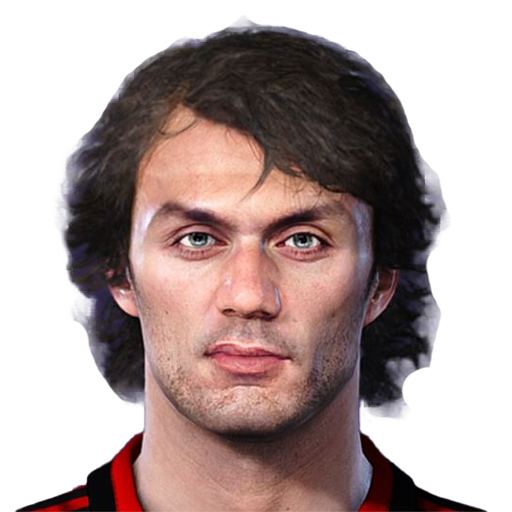
Paolo Maldini is the closest thing football has ever had to the concept of the “complete defender.” Not just great, not just consistent. Complete. If you were to build the perfect modern defender in a laboratory, you’d end up with him. Power, speed, intelligence, technique, leadership, longevity… everything was there, and nothing was missing.
He exploded early, a genuine prodigy. As a teenager he already played with the posture and clarity of a veteran, and from that moment on he basically never dipped. His career is a long, uninterrupted line of elite performances that stretched across eras, formations, coaches and tactical philosophies. Very few players in history maintained that level for that long. Maldini made it look normal.
Athletically, he had the whole package: strong in duels, fast in open field, explosive over the first steps, and balanced enough to change direction without losing tempo. His interventions were always clean, he didn’t lunge, he didn’t gamble, he just arrived exactly when he needed to. His timing was so sharp it felt like he was defending in slow motion while everyone else rushed around him.
Technically, he was miles ahead of the stereotypical centre-back. Comfortable on the ball, crisp in the pass, secure under pressure. And because he was naturally ambidextrous, his versatility became almost absurd: world-class at left-back for a decade, and then world-class again as a centre-back. Two different positions, two different eras, same dominance.
What made him truly exceptional, though, was his intelligence. Maldini processed the game with a rare calm; he always knew where to stand, how to shade the angle, when to step and when to retreat. He defended with his brain first and his body second. It’s no surprise he formed some of the greatest defensive units the sport has ever seen, first with the old-school Milan of the late ’80s and early ’90s, then with the more modern backlines built under Ancelotti. In every version of Milan’s defence, he was the constant, the axis everything rotated around.
And wherever he went, respect followed. Maldini became the emblem of professionalism: never theatrical, never disrespectful, always composed. Opponents, teammates, referees, everyone spoke about him with the same tone, a mix of admiration and resignation. You could beat Milan, but you never really “beat” Maldini.
There’s also the lineage. Being Cesare Maldini’s son could have crushed a lesser player. Instead, he went further, much further. He didn’t just extend the family tradition; he redefined it. Maldini became a dynasty by himself.
Ask around in the football world and you’ll hear the same verdict repeated with little debate: he is, for many, the greatest and most complete defender the game has ever produced. Not because he excelled at one thing, but because he excelled at everything for twenty-five years straight.