


Physical Skills
Technical Skills

Tactical Skills

Mental Skills

Attacking Skills

Defensive Skills

Legacy

Identity

Pref. Moves
– Cuts inside
– Shoots with power

Stats
Club
Apps: 534
Goals: 228
Goal Ratio: 0,42
Career Span (yrs): 22
National Team
Apps: 29
Goals: 8
Goal Ratio: 0,27
Career Span (yrs): 9
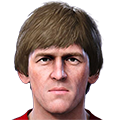
Billy Liddell was one of the defining figures in Liverpool’s history between the 1950s and early 1960s, a player whose impact went far beyond goals and appearances. His influence on the club was so overwhelming that the team was often nicknamed “Liddellpool” , half irony, half undeniable truth.
Primarily an attacking winger, Liddell was anything but decorative. He played wide, yes, but always with the mindset of a forward rather than a supplier. More inclined to finish than to assist, he attacked the box relentlessly, turning wide positions into launching pads for direct, devastating football.
Physically, he was a force of nature. Powerful, fast, aggressive, and fearless, Liddell combined speed with strength in a way that was rare for his era. Technically sound , not flamboyant, not ostentatious , he compensated for any lack of refinement with an exceptional dribble and a shot of extraordinary power. His left or right foot made little difference: he could strike cleanly with both, and he was lethal from the penalty spot. Add to that strong heading ability and a ruthless edge in front of goal, and you get a winger who behaved like a centre–forward whenever the chance arose.
What made Liddell even more remarkable was the contrast between the player and the man. On the pitch he was aggressive, relentless, uncompromising. Off it, he was a gentleman: impeccably professional, disciplined, respected by teammates, opponents and supporters alike. A leader without theatrics, a reference point through example rather than noise.
With the Scottish national team, Liddell performed solidly and consistently, though his international stage was inevitably limited by the overall quality of the squad and the historical context. Opportunities to shine on the biggest platforms were few, but his value was never in doubt.
Billy Liddell represents a particular idea of footballing greatness: not built on glamour, but on responsibility, power, and presence. A one-man reference system for Liverpool in difficult years, and a reminder that legends are not always born in dominant teams , sometimes, they are the team.
Liddell's Skills
On a chilly post-war afternoon at Anfield, a familiar cry echoed from the Kop: “Give it to Billy!” Such was the faith in one man that Liverpool Football Club even acquired the nickname “Liddellpool” in the 1950s theguardian.comliverpoolfc.com. Billy Liddell was more than just a star winger; he was the beating heart of a struggling team and a city’s hero through austerity. A Scottish farm-town boy turned Royal Air Force pilot and one-club icon, Liddell’s story is woven into Liverpool’s fabric. He combined breathtaking football talent with unwavering loyalty and gentlemanly conduct – a “perfect sportsman” admired by teammates and rivals alike theguardian.com. To understand why supporters of that era revered him as “King Billy”, and why the club’s very name morphed to honor him, we must journey through his life and times: from the Fife mining village of his youth, through the battlefields of wartime football, to the mud and glory of post-war English pitches.
Liddell’s legacy is etched not in a cabinet full of trophies, he won only a single major honor, but in the collective memory of Liverpool fans who saw him carry their club almost single-handedly theguardian.comlfchistory.net. Who was really Billy Liddell? He was, in short, a “gentleman, a scholar, and a fine football player,” as one former teammate put itpitchpublishing.co.uk. He was the “express train” down the wing, the tireless captain who never lost faith, and the local magistrate who remained a pillar of the community long after hanging up his boots pitchpublishing.co.ukpeterkj.wixsite.com. In this in-depth historical feature, we delve into Liddell’s life on and off the pitch – his biography and career timeline, his playing style and statistics (and how they stack up across sources), the legend of “Liddellpool”, anecdotes from those who knew him, and a measured assessment of his legacy at Liverpool and in Scottish football.
From Fife to Anfield: A Hero’s Journey Through War and Glory
Early Life in Scotland: William Beveridge Liddell was born on 10 January 1922 in Townhill, a mining village near Dunfermline, Fife theguardian.com. The eldest of six children, Billy was raised with a strong work ethic by his father, a coal miner who was determined that his son would not follow him into the pits theguardian.com. His father, who later died of a miner’s lung disease (silicosis), insisted that young Billy get an education and a stable backup career theguardian.com. This guidance would shape Liddell’s character: even as he pursued football, he trained as an accountant – a rare combination of scholar and sportsman that set him apart lfchistory.nettheguardian.com. As a schoolboy, Billy’s athletic talent was evident in multiple sports. He played football for his school and local youth sides (even dabbling in rugby at Dunfermline High), and at age 15 he joined the junior club Lochgelly Violet peterkj.wixsite.comtheguardian.com. Tall and strong for his age – he would stand 5’10” and weigh around 12¾ stone (81 kg) at his peak theguardian.com – Liddell combined robust physique with natural speed. Local spectators were soon marveling at his “terrific pace and cannonball shooting power,” as one retrospective recalled lfchistory.net. In 1938, during a local match, fate intervened: Liverpool’s Matt Busby (then a veteran half-back for the Reds) was in Scotland and happened to watch the teenaged Liddell play theguardian.com. Busby immediately spotted a gem. As he later told the story, he had been due to play golf with a friend, but when those plans fell through, he went along with a colleague to scout a young winger – and was “to look at the young Liddell” instead theguardian.com. Impressed by the boy’s ability, Busby recommended Billy to Liverpool manager George Kay, alerting him that “this Liddell lad might be worth an enquiry” lfchistory.net.
Liverpool acted quickly. In July 1938, the 16-year-old Liddell traveled south to Merseyside (chaperoned by Liverpool player Willie Fagan on the train) to join the club as an amateur thesefootballtimes.cothesefootballtimes.co. His starting wage was a mere £1 per week – essentially pocket money – but it would rise to £5 per week when he signed professional forms on 17 April 1939 thesefootballtimes.co. Crucially, Liddell’s parents negotiated conditions into his contract: the club agreed to find him proper housing, allow him to continue his studies, and even set him up with part-time work at an accountancy firm in the city thesefootballtimes.copeterkj.wixsite.com. Liverpool duly placed him as a trainee at a firm on Chapel Street, ensuring he could attend classes and work towards his accountancy qualifications while training twice a week lfchistory.netpeterkj.wixsite.com. This was an unusual arrangement – “he was the only Liverpool player who held two jobs” at the time, notes one account lfchistory.net – but it exemplified the club’s and the family’s foresight. If football didn’t pan out, Billy would have a profession to fall back on. It also spoke to Liddell’s discipline: even as a teenager, he balanced books by day and football by night, earning him a reputation as a model professional years before he played a first-team game.
Wartime Service and “War’s Best Find”: Any dreams of early stardom were soon interrupted by world events. In September 1939, the Second World War broke out, leading to the suspension of official league football. Like many young men, 17-year-old Liddell answered the call of duty. The Football Association encouraged players to set an example by enlisting, and Billy was a willing volunteer thesefootballtimes.co. He joined the Royal Air Force in 1940, training as a navigator and pilot in Bomber Command billyliddell.org.uktheguardian.com. By his own later account, he never saw active combat – something that actually disappointed him, as he felt he hadn’t fully “done his part” in the war thesefootballtimes.co. Nevertheless, Pilot Officer Liddell served as a pathfinder, guiding bomber missions, and was posted for a time to Manitoba, Canada lfchistory.net. War could easily have derailed a football career, but Liddell was fortunate to be able to keep playing in unofficial matches throughout the conflict. Stationed in England and Canada at various times, he turned out as a guest player for several teams, including Chelsea, Linfield, Cambridge Town, and even a Canadian side (Toronto Scottish), whenever he had leave lfchistory.netbillyliddell.org.uk. These scratch matches weren’t taken lightly – wartime football in Britain was fiercely competitive and drew large crowds starved for entertainment.
Liddell wasted no time making a name in those games. On New Year’s Day 1940, he pulled on a Liverpool shirt for the first time in a wartime fixture and promptly scored in a 7–3 win over Crewe Alexandra lfchistory.net. Reports from that match praised the 18-year-old’s “most promising display, [with] ball control and sense of positioning being features” lfchistory.net. Over the next few years, he became one of the outstanding young talents in wartime football. He made a total of 154 wartime appearances for Liverpool, scoring 83 goals in those unofficial competitions lfchistory.netlfchistory.net – a remarkable output that had newspapers touting “Liddell as war’s best find” as early as 1940lfchistory.net. Perhaps his most famous wartime exploit came on 18 April 1942, when the 20-year-old Liddell pulled on Scotland’s jersey – albeit in an unofficial wartime international – to face England at Hampden Park. Liddell lined up alongside Scottish greats like Bill Shankly (a future Liverpool manager) and England’s Stan Matthews in a charity match that drew 135,000 spectators to Hampden billyliddell.org.uk. By all accounts, the young winger stole the show. A Scottish press reporter dubbed him “Maestro Liddell” after he scored a headed equalizer and set up another goal with a dazzling run and cross, helping Scotland to a rousing 5–4 victory lfchistory.net. “Ten minutes was sufficient for this boy to play himself into these critical, hard-beating Hampden hearts,” the writer gushed, praising Liddell’s two-footed skill and calling one of the goals “one of the greatest Hampden has ever seen” lfchistory.net. Scots, starved of good news, had a new hero. Billy’s wartime performances were so impressive that by his early twenties his name was already familiar to football fans across Britain, even before he’d played a single official league match.
Post-War Debut and Instant Impact: With the war over in 1945, organized football resumed and Billy Liddell at last got the chance to wear Liverpool’s red in official competition. After a six-year wait since signing, he made his senior debut on 5 January 1946 in the FA Cup (the first tournament held as football restarted) liverpoolfc.com. Fittingly, the match was against Chester and took place not at Anfield but at Sealand Road in Chester – a two-legged Cup tie designed to ease teams back into action. Liddell, now 24, marked the occasion in style by scoring in the 30th minute of a 2–0 victory billyliddell.org.uk. Among the other debutants that day was a certain Bob Paisley, the future Liverpool manager; it was truly a new dawn at the club billyliddell.org.uk. Liddell’s league debut had to wait until the autumn of 1946, as he was still completing his RAF demobilization and missed the start of pre-season lfchistory.net. When he did step onto the Anfield pitch for his first First Division match on 7 September 1946, he wasted no time announcing himself. Liverpool faced Chelsea in a thrilling game that ended 7–4 to the Reds, and Liddell scored twice lfchistory.net. His very first league goal was a spectacular direct conversion of a corner kick at the Kop end just three minutes into the match lfchistory.net. Swinging the corner in with his left foot, he put so much power and curl on the ball that it flew straight into the net – an “Olympic goal” that sent the crowd into raptures. It was a sign of things to come: Liddell’s left-wing deliveries were so fierce that he would score directly from corners twice in his career lfchistory.netlfchistory.net, a rarity in any era. That day, the Liverpool Daily Post reporter (the legendary Leslie “Bee” Edwards) noted that Liddell, though not yet fully match-fit after military service, was already indispensable to the team: “Liddell means so much to his side,” Edwards wrote, underscoring that even a half-fit Liddell drew extra attention from Chelsea’s defense lfchistory.netlfchistory.net. The fans on the Kop evidently agreed – their thunderous welcome of the “Flying Scotsman” became a staple of every match.
Liddell’s first full season (1946–47) proved historic for Liverpool. Playing as an attacking left-winger in manager George Kay’s W-M formation (the 2-3-5 shape typical of the time), Billy was ever-present, appearing in 34 of 42 league matches and scoring 7 goals billyliddell.org.uktheguardian.com. He wasn’t the club’s top scorer that year – forwards Jack Balmer and Albert Stubbins notched more – but Liddell’s contributions were vital in a very tight title race. In an era of heavy, sodden pitches and a much slower, heavier leather ball, Liddell’s pace and drive gave Liverpool an edge. Teammate Bob Paisley later revealed that manager Kay’s simple tactical instruction in those days was, “Give the ball to Billy whenever you can, and he’ll win it for us,” and Paisley added, “He usually did too.” lfchistory.net. Indeed, on the final day of the season, Liverpool clinched the 1946–47 Football League championship, the club’s first league title in 24 years liverpoolfc.com. It came down to a “spectacular finish” in a post-war season extended into late July by bad weather lfchistory.net. Liddell’s role was significant: aside from his seven league goals, he had also scored a crucial goal in the FA Cup third round replay that helped set the tone in January lfchistory.net. While he was not yet the team’s main marksman, opponents already feared him. England’s right-back Alf Ramsey – later a World Cup-winning manager – confessed that as a defender for Tottenham, “I always knew I was in for a hectic afternoon when I was marking Billy. The only way to try to hold him was to beat him to the ball. Once he had it, he was difficult to stop.” theguardian.comtheguardian.com. Ramsey’s respect was echoed by many who faced Liddell’s exhilarating pace and power on the flank soccerhistory.co.uk.
Liverpool’s championship in 1947, achieved with a squad still rebuilding after the war, briefly suggested a new era of success at Anfield. At 25, Liddell had the football world at his feet. He scored in double figures in each of the next several seasons, evolving from a quick left-wing raider into a more rounded forward who could play on either wing or even switch into the center when needed billyliddell.org.uktheguardian.com. He became renowned for his ferocious shooting ability – his nickname around Merseyside, “Billy Hardshot,” reflected the fear he struck into goalkeepers with drives from 30 yards. Contemporary reports often remarked that “opponents were frightened to death” when this mild-mannered man wound up a shot lfchistory.net. Yet for all his firepower, Liddell was unerringly fair. He never lost his temper on the pitch, never retaliated to rough challenges, and astonishingly, he was never booked (cautioned) in his entire career peterkj.wixsite.com. In an era of crunchy tackles and primitive refereeing, that clean record is a testament to his sportsmanship. As Brian Glanville later wrote, Liddell was “fast, hard but impeccably fair” – almost “too good to be true” theguardian.com. One famous incident highlights this reputation: in a Scotland-England match at Hampden, Liddell collided with England’s keeper Frank Swift with such force that Swift’s ribs were broken. As Swift was stretchered off, he waved off any grudge, insisting “It was fair. Billy doesn’t know how to be anything but fair.” theguardian.comtheguardian.com. Liddell’s combination of strength and integrity earned universal respect. England captain Billy Wright, a frequent opponent, said “Scotland have had few greater players. [Liddell] could conjure goals out of nothing.” theguardian.com. And Matt Busby, who had convinced him to join Liverpool years before, admired that “there wasn’t a weakness in Billy’s game… He was as strong as a bull on the ball. Defenders found him a real handful, but always respected him.” theguardian.com.
Cup Finals and “Liddellpool”: The late 1940s brought near misses as well as personal accolades. In 1948, Liddell was Liverpool’s top scorer for the first time, and he continued to lead the club’s scoring charts in season after season. In fact, between 1949 and 1958 he finished as Liverpool’s leading scorer in all competitions in eight out of ten seasons – an extraordinary run that underscores how crucial he was to the team liverpoolfc.combillyliddell.org.uk. The Kop’s faith in Liddell bordered on reliance; fans and pundits began to quip that Liverpool had become “a one-man team.” The quip turned into a nickname: by the early 1950s the press had christened the team “Liddellpool,” reflecting that often it was Liddell’s goals and performances that kept Liverpool competitive peterkj.wixsite.comtheguardian.com. Liddell himself downplayed such talk – his cousin recalls that Billy “always said there was everyone in the team, it was not just him”, typical of his humility pitchpublishing.co.uk. But there is no denying that his influence was outsized. Teammate George Scott later remembered that when Bill Shankly arrived as manager in 1959, “he told us at the beginning that the club was called Liddellpool [in the ’50s]. [Billy] carried that team… the main man.” pitchpublishing.co.uk.
One of Liddell’s most celebrated campaigns was the 1949–50 season, when he spearheaded Liverpool’s run to their first ever Wembley FA Cup final. That spring, Liddell was in scintillating form. In the FA Cup semi-final against Merseyside rivals Everton, held at Maine Road, Manchester, he scored a crucial goal in a 2–0 win to send Liverpool to the final liverpoolfc.comliverpoolfc.com. The city – red and blue alike – hailed him; even the vanquished Evertonians could appreciate the quality of Liverpool’s talisman that day. The 1950 FA Cup Final, played on 29 April at Wembley, pitted Liverpool against Arsenal. It was Liverpool’s maiden appearance in an FA Cup final (a surprisingly late first, given the club’s history) and tens of thousands of Liverpudlians traveled to London, many for the first time. Liddell, naturally, was the focal point of pre-match media attention: could Arsenal’s defense stop the “Flying Scotsman”? Tragically for Liverpool, the answer was yes – by foul means. Arsenal’s robust Scottish half-back Alex Forbes shadowed Liddell closely and early on delivered a heavy challenge that left Billy nursing an injured shoulder lfchistory.net. Contemporary reports describe Liddell being “kicked from pillar to post” during the match lfchistory.net. He tried to carry on, but with no substitutions allowed in that era, Liverpool were effectively hampered by their star’s reduced capacity. Arsenal won 2–0, and a disappointed Liddell admitted, “I couldn’t put my jacket on the next day” due to the bruising lfchistory.net. The Spectator magazine’s journalist J.P.W. Mallalieu famously wrote that the result was not “Lucky Arsenal” but “just a little dirty”, lamenting that the neutral fan had been denied a real contest by the cynical targeting of Liddell theguardian.com. It was a rough lesson in the realities of top-level football. Still, Liddell took it with grace. He never publicly complained about the aggressive treatment, and indeed Forbes – a fellow Scot – later expressed that he meant no harm; it was simply how the game was played at the time.
Despite the FA Cup heartbreak, Liddell’s stature only grew in the early ’50s. Week in, week out, huge crowds at Anfield would roar any time the ball reached his feet. Fans knew that with Billy on the pitch, Liverpool always had a fighting chance no matter the opposition. One oft-recounted memory is the collective intake of breath on the Kop when Liddell picked up possession and sized up a shot – “the anticipation from the crowd was just huge. What is he going to do with it? Shoot from 30 yards or take it past people?” remembered Ian Callaghan, a schoolboy fan in the ’50s who later replaced Liddell on the wing lfchistory.netlfchistory.net. Liddell delivered plenty of long-range thunderbolts and mazy dribbles alike. In one league match in December 1951, he destroyed Tottenham Hotspur almost single-handedly, scoring a hat-trick in a famous 3–2 win at White Hart Lane lfchistory.netlfchistory.net. The Liverpool Echo’s headline captured it poetically: “Spurs have the bark, but Liddell’s hat-trick carries the bite.” Big performances in big games became a hallmark of his. Another highlight came in September 1953, when he scored four goals in a span of just four minutes during a Second Division game at Blackburn – an almost unbelievable scoring blitz that left home fans at Ewood Park speechless. By this time, the phenomenon of “Liddellpool” was both blessing and curse: Liverpool were increasingly a one-man show, and if Liddell had an off day or was marked out of a game, the team struggled badly. Season after season in Division One, the Reds finished mid-table despite Liddell’s heroics. As one retrospective put it, Liverpool “flirted with relegation in the early and mid-fifties and it was a lot to do with Billy’s ability that [they] avoided relegation for as long as they did.”billyliddell.org.uk Eventually, however, the limits of a one-man carry job were exposed.
Table 1: The Statistical Dominance of Billy Liddell (1950-1958)
The following table illustrates Liddell’s overwhelming contribution to Liverpool’s goal tally during the “Liddellpool” years. Note his transition to a central striker role post-relegation.
| Season | Division | Liddell Goals (League) | Total Team Goals | Liddell % of Team Goals | Top Scorer Status |
| 1950-51 | Div 1 | 15 | 53 | 28.3% | Top Scorer |
| 1951-52 | Div 1 | 19 | 57 | 33.3% | Top Scorer |
| 1952-53 | Div 1 | 13 | 61 | 21.3% | Top Scorer |
| 1953-54 | Div 1 | 7 | 68 | 10.3% | 2nd (Sammy Smyth 13) |
| 1954-55 | Div 2 | 30 | 97 | 30.9% | Top Scorer |
| 1955-56 | Div 2 | 32 | 85 | 37.6% | Top Scorer |
| 1956-57 | Div 2 | 21 | 82 | 25.6% | Top Scorer |
| 1957-58 | Div 2 | 22 | 79 | 27.8% | Top Scorer |
Relegation and Unwavering Loyalty: In 1953–54, Liverpool’s luck finally ran out. The team’s form collapsed and they ended the season bottom of the First Division, suffering the club’s first relegation in over 50 years. Tellingly, that 1953–54 campaign was the only season since the war in which Liddell was not Liverpool’s top league scorer liverpoolfc.com – a sign that even the great man had an off year (managing “only” 7 goals) as age and the immense burden began to toll. It was a bleak moment for the club. Many assumed Billy Liddell, by then 32 years old and still a star international, would leave for a top-flight team. In fact, offers came flooding in, including lucrative deals from abroad. One audacious proposal came from Colombia’s rebel league, which in the early ’50s was signing foreign stars outside FIFA’s jurisdiction – Liddell was reportedly offered £2,000 to play in South America peterkj.wixsite.com (a hefty sum at the time, roughly equivalent to a year’s wage for him). Scottish clubs and several English First Division sides were also interested. Yet Liddell’s response was swift and firm: he stayed with Liverpool, determined to help them regain their status liverpoolfc.competerkj.wixsite.com. This loyalty further endeared him to the Anfield faithful. As the official club history notes, his decision to remain despite relegation “further strengthened the bond he enjoyed with the Kop faithful.” liverpoolfc.com Liddell was now captain and the undisputed leader of the team, and he seemed to take the Second Division as a personal challenge.
Manager Don Welsh (who had overseen the relegation) reconfigured the side in the summer of 1954. Recognizing that Liddell’s explosive pace could be even more devastating in the middle, Welsh moved him from left-wing to centre-forward. At the same time, Billy took on the club captaincy, leading a younger squad in unfamiliar second-tier grounds. The results were spectacular on an individual level. Liddell immediately became a goal-scoring machine in the Second Division, freed from having to hug the touchline. In 1954–55, his first season after the drop, he scored 30 league goals (31 in all competitions) lfchistory.net – by far a career high and an astonishing tally for a player who had spent a decade as a winger. The following year he notched 32 goals in all competitions lfchistory.net. Over five seasons in the Second Division (1954–59) Liddell plundered 115 goals, an average of 23 per season lfchistory.net. For context, these numbers rivaled the best strikers in England. His 30-goal haul in 1954–55 included many a penalty and free-kick, as he resumed duties as Liverpool’s chief set-piece taker. With his powerful and accurate shot, Liddell was deadly from the spot – he ultimately scored 34 penalties for Liverpool in official matches lfchistory.net. He could even surprise goalkeepers directly from corner kicks, as noted, and tallied a few goals from direct free-kicks as well lfchistory.net. Second Division defenders, many of them part-timers, simply couldn’t handle him; stories abound of two or even three men trying to mark Liddell out of games, often unsuccessfully. A young Liverpool reserve at the time, Alan Banks, later marveled: “He engineered spirit in the fans just by playing for us… I put him alongside Kenny Dalglish and Steven Gerrard as the three best players ever to play for this club.” pitchpublishing.co.uk That Liddell could still dominate games well into his 30s spoke to his extraordinary fitness and durability. He rarely missed a match through injury, despite enduring weekly physical battering. In one stretch from 1954 to 1957, he appeared in over 100 consecutive league games billyliddell.org.uk. And though he was “never a shrinking violet on the pitch,” delivering robust challenges of his own, he maintained his spotless disciplinary record – never once did the referee take his name peterkj.wixsite.com.
If any criticism could be leveled, it was that Liddell at times tried to do too much himself. A Daily Mirror feature in 1957 dubbed him “the emperor of Merseyside” but wondered if Liverpool’s reliance on him was holding back the team’s development lfchistory.netlfchistory.net. The club cycled through managers – Don Welsh was replaced by Phil Taylor – yet promotion eluded them, often narrowly. Liddell’s own performance could still wow the nation: he remained in demand for representative teams, and in 1955, despite Liverpool being in Division Two, Billy was selected for a Great Britain XI (alongside legends like Stanley Matthews) to play a Rest of Europe side in Belfast billyliddell.org.uk. He thus became, with Matthews, one of only two players to appear in both the 1947 and 1955 Britain vs Europe exhibition matches soccerhistory.co.uk. He also continued to earn caps for Scotland well into his thirties. By 1955 he had been out of Scotland’s top division for a year, but after the national side suffered a humiliating 7–2 loss to England in April 1955, the Scottish selectors recalled Liddell from the “wilderness” of the Second Division peterkj.wixsite.com. His experience and class were put to use in Scotland’s European tour that spring: he scored in a 3–0 win over Portugal and in a 2–2 draw with Yugoslavia, and even tested his skills against the mighty Hungarian team of the era peterkj.wixsite.com. In total, Liddell won 29 official caps for Scotland, scoring 8 goals from 1946 to 1955 scottishfa.co.ukscottishfa.co.uk. (He also had four wartime “caps” that don’t count in the records.) Notably, he helped Scotland clinch the 1950–51 British Home Championship – scoring a goal in a famous 3–2 victory over England at Wembley in April 1951 en.wikipedia.orgenglandstats.com. That match saw him accidentally fracture England’s Wilf Mannion’s cheekbone in an aerial clash, underscoring his strength in the airenglandfootballonline.com. In fact, Liddell was an exceptional header of the ball; one report even credits him with scoring a header from outside the 18-yard box in a club match theguardian.comtheguardian.com, such was the power he could generate with his neck muscles. Small wonder that Liverpool’s center-half of the 1960s, Ron Yeats, later said he’d only seen one player head the ball harder than Liddell – and that was Yeats’ compatriot Alex Young, nicknamed “the Golden Vision.”
By 1958, however, time was catching up with “King Billy.” Liverpool’s failure to get promoted was hurting him at the national level – he was left out of Scotland’s squad for the 1954 World Cup (perhaps a relief in hindsight, given Scotland’s dismal showing) and by the late ‘50s younger forwards were emerging. At Anfield, change was afoot. Manager Phil Taylor resigned in 1959 after another near-miss season, and the board made the transformative appointment of Bill Shankly. Although Shankly arrived too late to see prime Liddell, he held the veteran in high esteem. Shankly kept Liddell in the side for the first few months of 1959–60 and later said he “certainly wished Liddell had been twenty years younger” to be part of the coming Liverpool revolution lfchistory.net. “Liddell was some player… He had everything,” Shankly effused. “He was fast, powerful, shot with either foot and his headers were like blasts from a gun. On top of all that he was as hard as granite. What a player!” lfchistory.netlfchistory.net. This encapsulates why Shankly and others considered Liddell the prototype of the modern footballer – complete in skill set and physicality, yet utterly dedicated to the team. Shankly’s arrival also coincided with Liddell’s final chapter as a player. Now 37 years old, Billy’s appearances became sporadic in 1959–60 as Shankly gradually introduced younger players (like Roger Hunt). Still, on opening day of the 1960–61 season, the 38-year-old Liddell pulled on the Liverpool shirt one last time. On 31 August 1960, he started in a Second Division match against Southampton at Anfield – his 534th official appearance for the club liverpoolfc.com. Fittingly for the devoted servant, he was captain that day. Liverpool lost 1–0, an anti-climactic end to an illustrious career, but the significance wasn’t lost on those present. Liddell walked off to a standing ovation; he had set a new all-time club appearance record (surpassing Elisha Scott’s 468 – a record which would stand until Ian Callaghan overtook him years later) lfchistory.net. Three weeks later, on 21 September 1960, Liverpool arranged a testimonial match for Billy – an opportunity for the fans and the city to say thank you. Nearly 40,000 packed into Anfield for a celebratory friendly between Liverpool and an International XI that included famous names like Stanley Matthews, Nat Lofthouse, Tom Finney, and Bert Trautmann lfchistory.net. In a fun twist, Liddell played a half for the International XI (to ensure he was on the pitch throughout) and even scored a goal against Liverpool, to the amusement of the crowd lfchistory.net. Liverpool won 4–2, and the gate receipts of about £6,000 were presented to Liddell – money he used to buy a house in Liverpool for his family lfchistory.net. Ever humble, Billy addressed the crowd and expressed his deep gratitude, saying it “hardly seems 22 years” since he had arrived a scared youngster, and that he was “proud to be accepted as a fellow Liverpudlian” lfchistory.netlfchistory.net. He thanked the “staunchest supporters in the land” for their encouragement through good times and badlfchistory.net. There were few dry eyes on the Kop that night.
When Liddell officially retired in the summer of 1961, just shy of age 39, it quietly closed the chapter on Liverpool’s post-war era. In total he had played 534 matches for Liverpool, scoring 228 goals in official competitions liverpoolfc.comlfchistory.net. (Some sources credit him with 537 appearances and 229 goals soccerhistory.co.uk, likely by counting wartime and Glasgow Cup fixtures, but the consensus for competitive matches is 534 and 228.) Those numbers were unprecedented for Liverpool at the time – “No other player had made more appearances for the club than King Billy” by 1960 lfchistory.net, and only two players had ever scored more goals (he finished behind Gordon Hodgson’s record 241, and just one ahead of the legendary Elisha Scott’s outfield contemporary, Harry Chambers). Considering that Liddell lost what would have been his early prime years to WWII, one can only wonder how much greater those stats might have been. As it stands, he averaged a goal every 2.3 games across 14 seasons billyliddell.org.uk – phenomenal for a player who spent much of his career as a winger rather than an out-and-out striker. He was also astonishingly versatile: he played every forward position (outside-left, outside-right, inside-forward on either side, and centre-forward) and even filled in as a midfielder when needed billyliddell.org.uk. Teammate Gerry Byrne recalled, “He could play anywhere… with both feet, left or right, on the wing or centre-forward. Brilliant player.” lfchistory.netlfchistory.net. Bob Paisley rated outside-left as Liddell’s best position “if I suppose”, but quickly noted that Billy “didn’t matter where he was playing” – he’d beat you one way or anotherl fchistory.netlfchistory.net.
Liddellpool: Legacy of a Liverpool Legend and Gentleman
When Billy Liddell hung up his boots, Liverpool were still languishing in Division Two, but within a few years Bill Shankly’s revitalized side would storm back to the top. Liddell’s only regret, as he expressed in his autobiography published in 1960, was that he couldn’t taste that success himself. “Everybody at Anfield hopes that in the not too distant future [Shankly] will lead the club back to the First Division and also to a cup final victory,” Billy wrote – and indeed Shankly did both, winning promotion in 1962 and the FA Cup in 1965 thesefootballtimes.cothesefootballtimes.co. “Sadly, the success which duly followed came too late for Liddell,” one writer noted, “however, his status as a Liverpool legend and icon was already assured.” thesefootballtimes.co. In Liverpool’s pantheon of greats, Liddell occupies a unique place. He was a shining light in one of the club’s darkest decades, a rare world-class player in a team that, by his own admission, was often average. Former captain Donald Mackinlay, who had starred in the 1920s, stated in 1955: “Liverpool have had some good club players, but I think [Liddell] is the finest in their history… Matthews is a great entertainer, but for me that Liddell man is ‘It’. He is one of the greatest club men ever to have played football.” lfchistory.netlfchistory.net. Here was a “club man” par excellence – someone who gave his entire playing life to one badge, and in turn became synonymous with that club. Even decades later, Liverpool supporters who never saw Liddell play have ranked him among the Reds’ all-time elite. In a 2006 fan poll on LiverpoolFC.com, Billy Liddell was voted the 6th greatest player in Liverpool history billyliddell.org.uk; he was the oldest-era player in the top 10, indicating the lore that still surrounds his name. (In a 2012 updated poll, he again figured high on the list thesefootballtimes.co.) This is especially remarkable given that there is scant video footage of Liddell – his prime predated most TV broadcasts. His legend has been carried forward largely by word of mouth, written accounts, and the reverence in which subsequent generations of Liverpool icons held him.
What made Liddell so revered? Part of it is surely his character and cultural impact beyond just goals and games. In the public eye, Billy Liddell represented an ideal of the virtuous sportsman that resonated deeply in post-war Britain. He was a devout Methodist – a “convinced Christian” who neither smoked nor drank theguardian.com. He married his wife Phyllis in 1946 and together they settled in Liverpool, raising twin sons. Throughout his career and beyond, Liddell was heavily involved in community work: he gave time to boys’ clubs and youth football, was active in his church, and was known for being approachable to fans theguardian.compitchpublishing.co.uk. In 1958, while still playing, he was appointed a Justice of the Peace (magistrate) in Liverpool – a role that spoke to the esteem he was held in as an upstanding citizen theguardian.com. Amusingly, local folklore has it that on occasion some petty offenders, upon finding “Mr. William Liddell” on the magistrates’ bench, would show up to court wearing a Liverpool scarf or jersey hoping to win favor. They rarely did – Billy was scrupulously fair and by-the-book in dispensing justice peterkj.wixsite.com. He had begun working as an accountant during his playing days and, after retirement, that became his full-time career; Liddell served as bursar (financial administrator) at the University of Liverpool in the 1960s theguardian.comtheguardian.com. On Saturday afternoons he remained a regular at Anfield as a modest season-ticket holder, blending into the crowd to watch the new generation under Shankly theguardian.com. It’s quite touching to imagine the man who was “Liddellpool” quietly taking his seat in the Kemlyn Road stand, just another supporter cheering the team.
Liddell’s modesty and professionalism left an indelible impression on those who met him. Ian Callaghan, who idolized Billy as a boy and then played alongside him as a teenager, said years later: “I got to know him and he was a really quiet and a really nice man. Terrific. He is one of those people who will always be remembered in Liverpool, like Shankly and Paisley.”lfchistory.netlfchistory.net. Callaghan also revealed how Liddell remained involved with the club informally – for instance, both of them served on the panel of judges for the Littlewoods Pools “spot the ball” contest in the ’70s, where Liddell was chairman lfchistory.net. Former teammates like Gordon Milne and Ronnie Moran often described Billy as a mentor figure, someone who led by example in training and was always approachable to younger players. Gerry Byrne recalled that as a raw 18-year-old he once had to mark Liddell in a practice match: “two defenders hanging off him and you still couldn’t shake him off the ball,” Byrne laughed, adding that Billy was “so strong… head and neck were all one”lfchistory.net. Yet off the pitch, this same fearsome competitor was gentle and encouraging to the youngster afterwards, giving him tips on positioning. Liddell’s sportsmanship extended to how he treated opponents as well – he would be first to pick up a fallen rival or to applaud a good save by the opposing keeper. Little wonder that when Liddell broke Elisha Scott’s appearance record in 1957, Liverpool presented him – tongue-in-cheek – with a cocktail cabinet as a gift theguardian.com, knowing full well that the teetotal Billy would likely use it to store his soft drinks and family china.
In terms of playing style and tactics, Billy Liddell can be seen as a footballer ahead of his time. In the late 1940s and 1950s, teams typically played the W-M formation (a 3-2-5 that requires wingers to stay wide and provide crosses). Liddell was a winger in the “old raiding tradition” – as Glanville put it, all about “pace, power and incisiveness” down the flanks theguardian.com – but he was not a one-dimensional touchline hugger. He had the dribbling skill and crossing ability of a classic winger, but also the physique and finishing of a center-forward. Increasingly, Liverpool gave him license to roam inside, making him more of a free-role forward by today’s standards. His two-footedness was a major asset; although left-footed by nature, Liddell could (and often did) shoot or cross with his right with nearly equal efficacy lfchistory.netlfchistory.net. This kept defenders guessing – if they showed him outside, he’d skin them on the left; if they overplayed his left, he’d cut inside onto his right. Danny Blanchflower, the great Spurs and Northern Ireland player, once quipped that Liddell could “go round you, or past you, or even straight through you sometimes! ”lfchistory.netlfchistory.net. Such versatility in attack was uncommon at the time. Moreover, Liddell was noted for his tremendous work rate and stamina. In an era when wingers were not expected to track back much, Billy’s natural fitness meant he could cover huge swaths of the pitch, helping out in defense and then sprinting 50 yards upfield to start a counter. One former opponent joked that Liddell “did a lot more running than I ever did”, comparing his engine to players of later generations who covered more ground lfchistory.net. Importantly, he played in heavy leather boots on muddy, often half-frozen pitches – conditions which make the modern observer marvel at his athletic feats. “Billy played with a heavy ball on the heavy pitches… The way he used to kick the ball, wow!” exclaimed Callaghan, noting how today’s lighter balls make it far easier to score long-range screamers lfchistory.netlfchistory.net. The fact Liddell could regularly find the top corner from distance with those old balls speaks volumes of his technique and power.
To draw a modern comparison (imperfect though any cross-era analogy is), one might imagine a player with the explosive wing play of Cristiano Ronaldo in his early Manchester United days, combined with the muscular build and direct dribbling of a Gareth Bale, and the one-club loyalty of a Matt Le Tissier at Southampton. Liddell had a bit of all that: he was a prolific scorer from the wing like Ronaldo (228 goals is astonishing for a non-striker) and could physically dominate defenders much as a modern power forward would lfchistory.nettheguardian.com. Yet unlike Ronaldo or Bale, who eventually left for mega-clubs or richer pastures, Liddell stayed at a club that was – by his later years – no longer among the elite. In that sense, his loyalty and burden-carrying evokes someone like Le Tissier or Alan Shearer (who stuck with Newcastle in lean times). Another analogy sometimes used by Liverpool fans is Steven Gerrard, the club’s talisman of the 2000s: like Liddell, Gerrard was a homegrown hero who often seemed to drag a mediocre team to victory by sheer will (and who also had a thunderbolt shot). Indeed, the Liverpool website explicitly likened Liddell to Gerrard as “Liverpool’s modern talisman”, noting how each “inspired those around him” by talent and force of will liverpoolfc.com. The big caveat is that football in Liddell’s day was very different – truly a different sport in terms of tactics, training, and conditions. There were no substitutions (if you were injured, tough luck), no tactical pressing or zonal defenses as we know them, and sports science was nonexistent. Players had a beer and a meat pie after matches, and a maximum wage rule limited even stars like Liddell to about £20 a week (roughly £400 in today’s money). It was a working man’s game in every sense. Liddell, ever forward-thinking, participated actively in discussions about players’ rights and the state of the sport. In his 1960 autobiography “My Soccer Story”, he addressed the debate on whether footballers were underpaid “slaves.” Famously, he recounted arriving at training in his modest car and overhearing a passer-by quip, “The slaves don’t seem to be doing so badly, mate. I wish I was one of them.”thesefootballtimes.cothesefootballtimes.co – a wry observation that while players’ wages were capped, they still earned more than many ordinary workers. Liddell was not one to complain about money; in fact, he was somewhat skeptical of the push for higher wages, emphasizing that players should remain grounded. (Notably, the year after he retired, the maximum wage in English football was abolished in 1961 due in part to players’ union pressure – a fight Liddell observed but did not take a militant role in.) Instead, Billy was passionate about improving the fans’ experience and the sport’s integrity. He wrote a chapter decrying the “evils of barracking” – essentially telling supporters not to unfairly abuse their own team’s players or tolerate dirty play from their side thesefootballtimes.cothesefootballtimes.co. He argued if fans booed cheating by opponents, they should condemn it in their team too, to uphold fair play thesefootballtimes.co. He also anticipated modern developments: he proposed government loans to build better stadiums and even mused about a European league in the future. In one prescient passage, Liddell predicted that “nothing is more certain than in the course of time we shall see a European league established”, imagining teams jetting off from city to city in advanced planes that “take off vertically” and land right at the stadium thesefootballtimes.cothesefootballtimes.co. This vision was written in 1960 – decades before the Champions League or VTOL jets – showing Liddell’s keen interest in the evolution of football. While some of his ideas (like heated terraces for spectators) may have been naïve, they came from a good place: he loved the game and its supporters, and he thought deeply about its future. It’s fair to call him a “visionary” in that regard thesefootballtimes.cothesefootballtimes.co.
Back in Liverpool, Billy Liddell’s post-retirement years were spent quietly, but his legend never faded. In 2001, at the age of 79, he passed away after suffering from Alzheimer’s disease theguardian.com. The outpouring of tributes was immense. Brian Hall, one of Liverpool’s 1970s players, said Liddell’s name “was like magic” when he was growing up billyliddell.org.uk. The club unveiled a plaque at Anfield in Billy’s honor in November 2004, near the Kop entrance, ensuring match-goers would see his name among Liverpool’s greats soccerhistory.co.uk. He was also inducted into the Scottish Football Hall of Fame in 2008 peterkj.wixsite.com – a belated recognition in his homeland for a player somewhat underappreciated outside Merseyside. Indeed, Liddell’s relative lack of international exposure (no World Cup, few trophies) meant he wasn’t as globally famous as contemporaries like Stanley Matthews, Tom Finney, or Alfredo Di Stéfano. But those who knew the British game rated him at their level. Sir Tom Finney himself often included Liddell when discussing the best he ever saw. In 2010, in Liddell’s birthplace of Townhill, Fife, the local sports complex was renamed the Billy Liddell Sports Complex, and a memorial cairn was erected not far from his boyhood home billyliddell.org.uk. Perhaps the most fitting tribute of all came from Liverpool’s longest-serving player Ian Callaghan, who had inherited Liddell’s #11 shirt. Cally said: “The club used to be called ‘Liddellpool’ in the 1950s, which shows you just how much he was respected… In my opinion Liddell, Kevin Keegan and Kenny Dalglish were the three best Liverpool players ever, but I would put Billy ahead of the other two as the greatest.” lfchistory.netlfchistory.net. This assessment might spark pub debates across generations, but it underlines Liddell’s standing: for a man with no European Cup medals, no Ballon d’Or, and who spent years in the second tier, to be in the same breath as Dalglish (multiple champion and European Cup winner) says something profound. It says that greatness isn’t only measured in silverware. Billy Liddell’s greatness was of a purer kind – the kind that inspired unshakable devotion in those who saw him play, and earned unreserved admiration in those who played against him.
To answer the question posed at the outset – “Who was really Billy Liddell?” – we find that he was a multifaceted hero. He was the on-field force who could “drove through defences like a preoccupied tank” theguardian.com, yet off the field a kindly soul who taught Sunday school and signed countless autographs with a smile. He was “Mr. Liverpool” to the city’s fans pitchpublishing.co.uk, and also an internationalist who proudly wore Scotland’s dark blue (and even the United Kingdom’s colors) in an era of British isolation from FIFA. He was a man who stayed loyal when many would have jumped ship, and who in turn became a living symbol of loyalty for the club. Liverpool’s famous anthem says “At the end of a storm, there’s a golden sky” – in the footballing storm of the 1950s, Billy Liddell was that light for Liverpool supporters. His legacy endures in the stories still told on the Kop, the road in Liverpool that bears his name, and the way “Liddellpool” remains a byword for one player’s incredible impact on a team thesefootballtimes.co. Billy’s contemporary, the great Sir Stanley Matthews, was once asked to name the hardest shot he ever faced (Matthews occasionally went in goal in training). He replied, “Billy Liddell’s.” Matthews remembered one thunderbolt from Liddell that not only knocked him over, but left him thanking the heavens it hadn’t hit him in the head lfchistory.net. Power, skill, humility, and integrity – that was Billy.
In a 1950 interview, Liddell reflected on his journey, saying, “I’ve never regretted [joining] Liverpool… My most thrilling memory was the first goal I scored for Scotland, in my first international against England at Hampden Park in 1942.” lfchistory.net. For a generation of Liverpudlians, the most thrilling memories were those of Billy Liddell in full flight at Anfield, bearing down on goal, the crowd roaring in unison. Those memories have been passed on, and today, even in the gleaming era of the Premier League, the name Billy Liddell still shakes the Kop. Liverpool may now have stands named after Dalglish or statues of Shankly, but as one writer lamented, “There are no statues of Liddell at Anfield; no stands named after him… Perhaps his greatest accolade is the appreciation of the people.”thesefootballtimes.co. Indeed, the true monument to Billy Liddell is in the hearts of the supporters and the folklore of the club. He remains, simply, “A true gentleman in every sense of the word, and moreover a Liverpool legend”pitchpublishing.co.uk – the man who made Liverpool Liddellpool, and whose spirit of pride and professionalism still sets a gold standard for all who pull on the Liver bird crest.
Sources / References:
Brian Glanville, “Billy Liddell – Legendary Liverpool winger in the old tradition,” The Guardian, 4 July 2001. Accessed 5 Jan 2026. theguardian.comtheguardian.com
“Past Players: Billy Liddell,” Liverpool FC Official Website, n.d. Accessed 5 Jan 2026. liverpoolfc.comliverpoolfc.com
LFChistory.net (Arnie & K. Hinsch), “Player Profile: Billy Liddell,” (comprehensive stats and quotes), n.d. lfchistory.netlfchistory.net
Jeff Goulding, “Billy Liddell: The war hero, visionary and gentleman who became Liverpool’s darling of the Kop,” These Football Times, 17 Jan 2020. thesefootballtimes.cothesefootballtimes.co
Billy Liddell Memorial Group, “William ‘Billy’ Liddell – Liverpool, Scotland & GB Footballer,” (Digital Fife site), n.d. billyliddell.org.ukbillyliddell.org.uk
Peter Kenny Jones, “The Armchair Sportsman – Interview with Cowdenbeath FC (Billy Liddell at One Hundred),” Football Historian blog, 6 Oct 2021. peterkj.wixsite.competerkj.wixsite.com
Scottish Football Association, “Billy Liddell – Scotland Player Profile,” Scottishfa.co.uk, retrieved 5 Jan 2026. scottishfa.co.uk
Liverpool Daily Post (Leslie Edwards), “Liverpool dive but to come up again,” 1 May 1954 (via LFChistory.net scrapbook). lfchistory.net
LFChistory.net, Quotes from Teammates/Opponents (Paisley, Blanchflower, Callaghan, Mackinlay, Byrne), compiled 2008. lfchistory.netlfchistory.net
Liverpool Echo, “Spurs have the bark, but Liddell hat-trick carries the bite,” 1 Dec 1951 (match report, via LFChistory.net). lfchistory.net
Ian Callaghan (interview), “Cally’s Heroes – on Billy Liddell,” BBC Radio Merseyside, 2008 (via LFChistory.net). lfchistory.netlfchistory.net
“100 Players Who Shook The Kop – Billy Liddell (No.6),” Liverpoolfc.com, 29 Sept 2006. Accessed 5 Jan 2026. billyliddell.org.uk
The Spectator (JPW Mallalieu), “1950 FA Cup Final report,” May 1950 – quoted in Guardian obit. theguardian.com
EnglandFootballOnline, “England 2–3 Scotland (14/04/1951) match report,” detailing Liddell’s goal and Mannion injury. Accessed 5 Jan 2026. englandfootballonline.combritishpathe.com
National Football Museum (UK), “Hall of Fame: Billy Liddell profile,” 2008. Accessed 5 Jan 2026. peterkj.wixsite.com
(All online sources accessed on 5 January 2026. Quotations have been cited from the original or archival sources as indicated. Statistics have been cross-verified via LFChistory.net and official records; any discrepancies between sources are noted in the text.)